
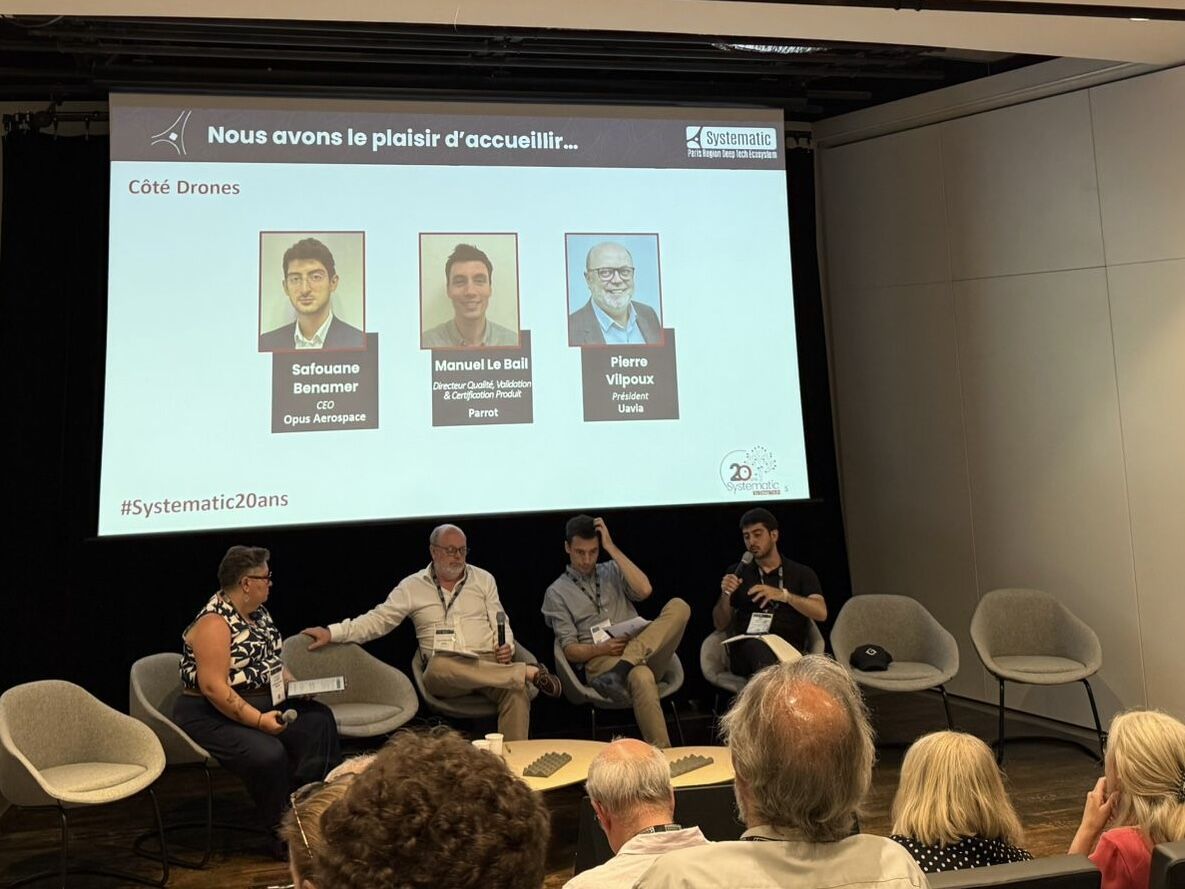
Uavia celebrated the 20th anniversary of Systematic Paris-Region, where our President, Pierre Vilpoux, spoke alongside Manuel Le Bail from Parrot and Safouane Benamer from OPUS Aerospace. They addressed the long-underrated cybersecurity challenges related to drone use, which now also impact launchers and space systems.
Cybersecurity concerns span the entire drone value chain, including mission supervision platforms, command and control (C2) systems, IT environments, telecommunication links, and embedded software and hardware intelligence. We shared insights into the depth of these challenges, which Uavia has been addressing for a decade, and emphasized the critical connection between cybersecurity and sovereignty. For security, safety, or defense applications, the investments a startup must make to address these challenges are substantial—often far exceeding the cost of application development itself.
Backdoors can be hidden in many low-cost or free software modules and development tools (SDKs). It is essential to maintain a cautious and expert eye on technological components from actors whose interests may not align with our sovereign priorities, as they can become “software time bombs.”
Behind economic battles lie sovereignty issues: purchasing low-cost software solutions with unauditable dependencies or hardware with unauditable embedded intelligence can act as Trojan horses, storing sensitive data for years. This data could be exploited in a coordinated attack enabled by future advancements in AI and quantum computing, whose capabilities we cannot yet fully predict. This is a risk that must be taken seriously.
The current economic climate is challenging: public buyers are constrained by clauses favoring low prices, which is understandable, while investors push startups to capture markets quickly. However, these pressures have their limits, and the first of these is sovereignty. Developing and securing technology in Europe comes at a cost, but this cost is a necessary investment for independence and prosperity. It fundamentally creates value. Startups and SMEs need contracts and investment resources to fight these battles. They are agile and resourceful but must be able to grow and continue building their strengths.